
Hard Work Is Not Enough
Nobody tells you when it stops working.

Most people feel it but cannot name it.
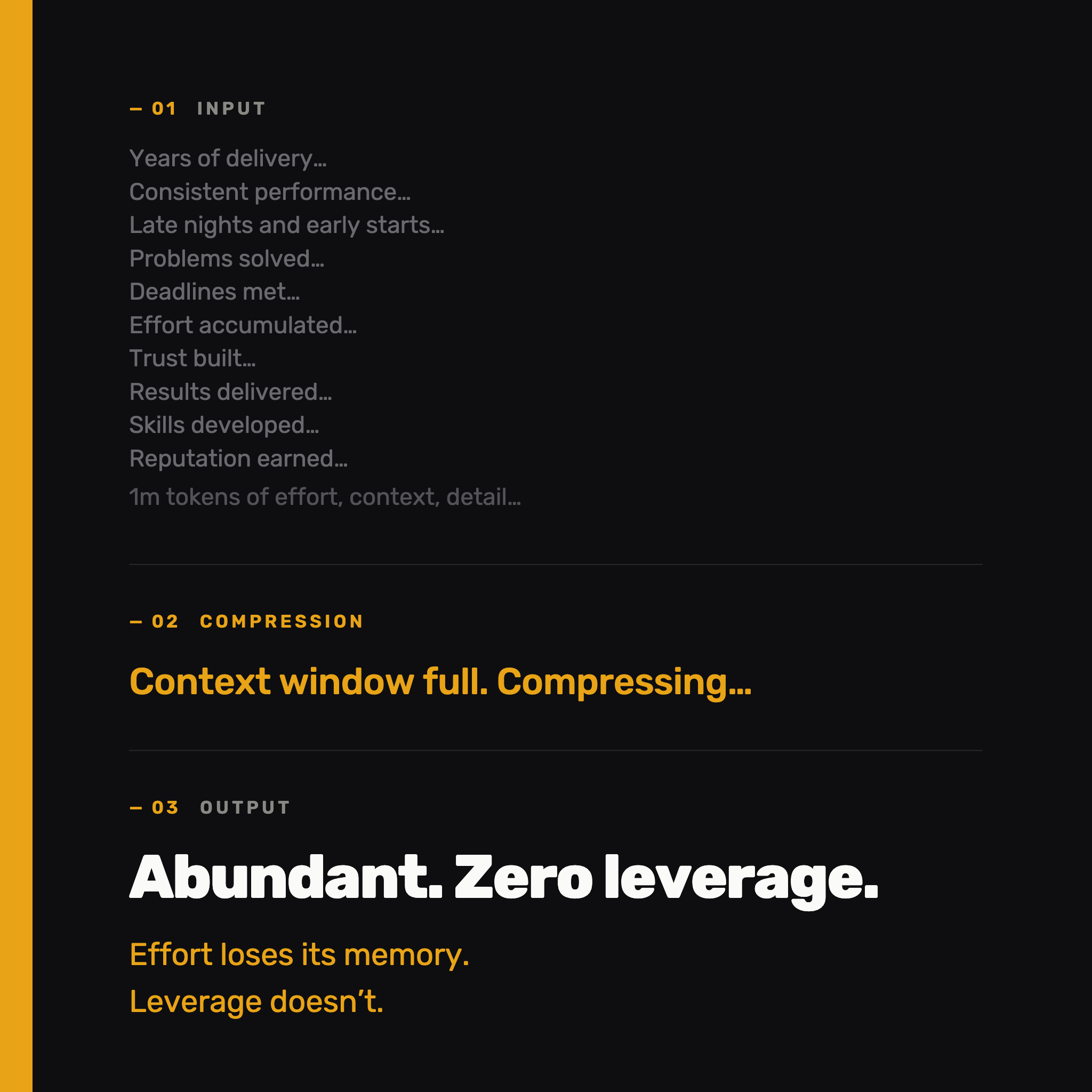
Think about how a context window works in AI. You are deep in a conversation. Everything is live. Every detail, every decision, every line of reasoning is present and connected. The model knows exactly what is happening and why.
Then the window fills. The compression comes.
All of that depth gets reduced to a summary. The outline is there. The shape of what happened is there. But the texture, the reasoning, the hours of work that built it, gone. Condensed into tokens that gesture at what existed rather than hold it.
I have lived that pattern more times than I can count.
Months inside a software project. The team locked in, pulling in the same direction, building something that had never existed before. Then it ships.
And within weeks the work is already becoming a summary. The detail of what it took, forgotten. The effort compressed into an output that the organisation moves on from. What remains is the system, not the story of how it was built.
That is not a technology problem. That is how organisations process work.
In the last few years of my corporate career I built a suite of greenfield technology applications and infrastructure that had never existed before. Not an iteration. Not an improvement. Something from nothing.
The recognition never came.
What came instead was more work. A push to build on what had been built, to improve on what had never existed, to keep delivering on a baseline that kept moving. I kept going. I told myself that if I delivered enough, for long enough, it would eventually be acknowledged.
It was not.
Looking back, the sharpest part of that experience is not the lack of recognition. It is the feeling of being trapped by my own output. The better I performed, the more indispensable I became to the process. The more indispensable I became, the less the organisation could afford to move me. I had built the walls of my own ceiling.
I only understood what had happened when I started writing the framework. I saw my own story in it immediately.
The belief
Hard work is rewarded. Most professionals carry this assumption into their careers for good reason. In the early years, it is true.
You work harder than the person next to you and you move faster. The feedback loop is clean. Input produces output. Output produces recognition.
Then it stops working. Not immediately. Gradually, then suddenly.
The environment changed. The game changed. But the strategy did not.
What got you here was effort. What gets you to the next level is leverage. Most people keep pulling the effort lever long after it stopped producing returns, because it is the only lever they know.
I pulled it for years.
What actually happened
The environment changed around me without announcing itself.
In the early stages, effort is a genuine differentiator. Most people at that level are not working that hard, not delivering that consistently. Standing out by working harder is a viable strategy because the bar is low enough for effort to clear it.
Then two things happen simultaneously.
Everyone around you starts working harder too. Effort stops being a differentiator because it becomes the baseline. Everyone at this level is reliable. Everyone delivers.
And the organisation stops selecting on effort and starts selecting on something else entirely.
What it selects on is scarcity.
What organisations actually reward
Organisations do not promote the hardest worker. They promote the person they cannot afford to lose from the next level up.
Those are not the same person.
The hardest worker is often the person they cannot afford to move from their current role. The person who holds the institutional knowledge, puts out the fires, keeps the engine running. Indispensable where they are. Impossible to promote without creating a problem.
That was me. I had built something irreplaceable and been rewarded with more work. The organisation needed me exactly where I was. It had no incentive to move me.
The person who gets promoted has built something the organisation needs at a higher level. Not more effort. A different kind of contribution. One that is harder to find, harder to replicate, harder to route around.
That is scarcity. And it has nothing to do with how many hours you logged.
The trap inside the belief
The belief that hard work is always rewarded is not just wrong. It is actively dangerous, because it directs your energy toward the wrong thing.
Every hour spent proving how hard you work is an hour not spent building something that compounds. Every late night fixing a problem that only you can fix makes you more indispensable to a process and less visible as a candidate for the next level.
I kept delivering and hoped recognition would eventually come. It did not. Because I was solving the organisation’s problem, not building my own leverage.
Deserving and receiving are different systems. Effort alone does not bridge them.
What compounds instead
The question that led me to write Scarcity Algorithm was not how do I work harder.
It was: what do I build that keeps working when I stop?
Effort gets compressed. The fires you put out last quarter are forgotten. The late nights are absorbed into the baseline expectation. The reliability that felt like a differentiator becomes the minimum requirement, invisible until it fails.
What survives compression is different. A framework someone else uses. A reputation that precedes you into rooms you have not entered yet. A body of work that signals something the organisation cannot easily find elsewhere.
These things do not require you to stop working. They require you to be deliberate about what the work produces beyond the immediate output.
The reframe
Hard work is not the problem. Hard work in service of abundant output is the problem.
The question is not whether to work hard. It is whether the work you are doing is building something scarce or just maintaining something that anyone sufficiently reliable could maintain.
I spent years maintaining something irreplaceable and being rewarded with more maintenance. The exit was not working less. It was understanding that the framework I was building in my own head was worth more than anything I was building for someone else.
Hard work got me there. It did not get me out.
Understanding the difference did.
Effort loses its memory. Only scarcity survives compression.