
The Scarcity Filter
I have built things I should have bought more times than I want to admit.


Twenty years in software engineering gives you a dangerous superpower. You can look at almost any tool, any platform, any SaaS subscription and think: I could build that. And you would be right. Most of the time you actually could.
Right now the default move for anyone with a technical background is to spin up their own version of whatever they are paying for. Custom CRM. Bespoke analytics dashboard. Self-hosted everything. The tools exist. The skills exist. The logic feels sound.
But the logic is wrong.
I have built solutions that ended up incomplete. I have built things that worked but consumed months I did not have. I have built the technically correct answer to the wrong question. And every time, the real cost was not the hours. It was what I was not building while I was building the wrong thing.
That pattern is what gave me the filter.
The question underneath everything
Most professionals sort their work into two buckets. Important and not important. Urgent and not urgent. High value and low value.
These are the wrong splits.
The question that actually determines whether your work builds leverage or consumes it is simpler and sharper than any of those.
Is this work scarce or abundant? And am I the one doing it?
Scarce work is work that requires you specifically. Your judgement. Your voice. Your relationships. Your original thinking. Work that loses something essential if someone else does it, or if a tool generates it.
Abundant work is everything else. Competent, useful, necessary, but available. Anyone sufficiently capable could do it. A tool could do it. Another person could do it. It does not require you to be you.
Those two questions produce four answers. Only one of them builds leverage.
The four quadrants
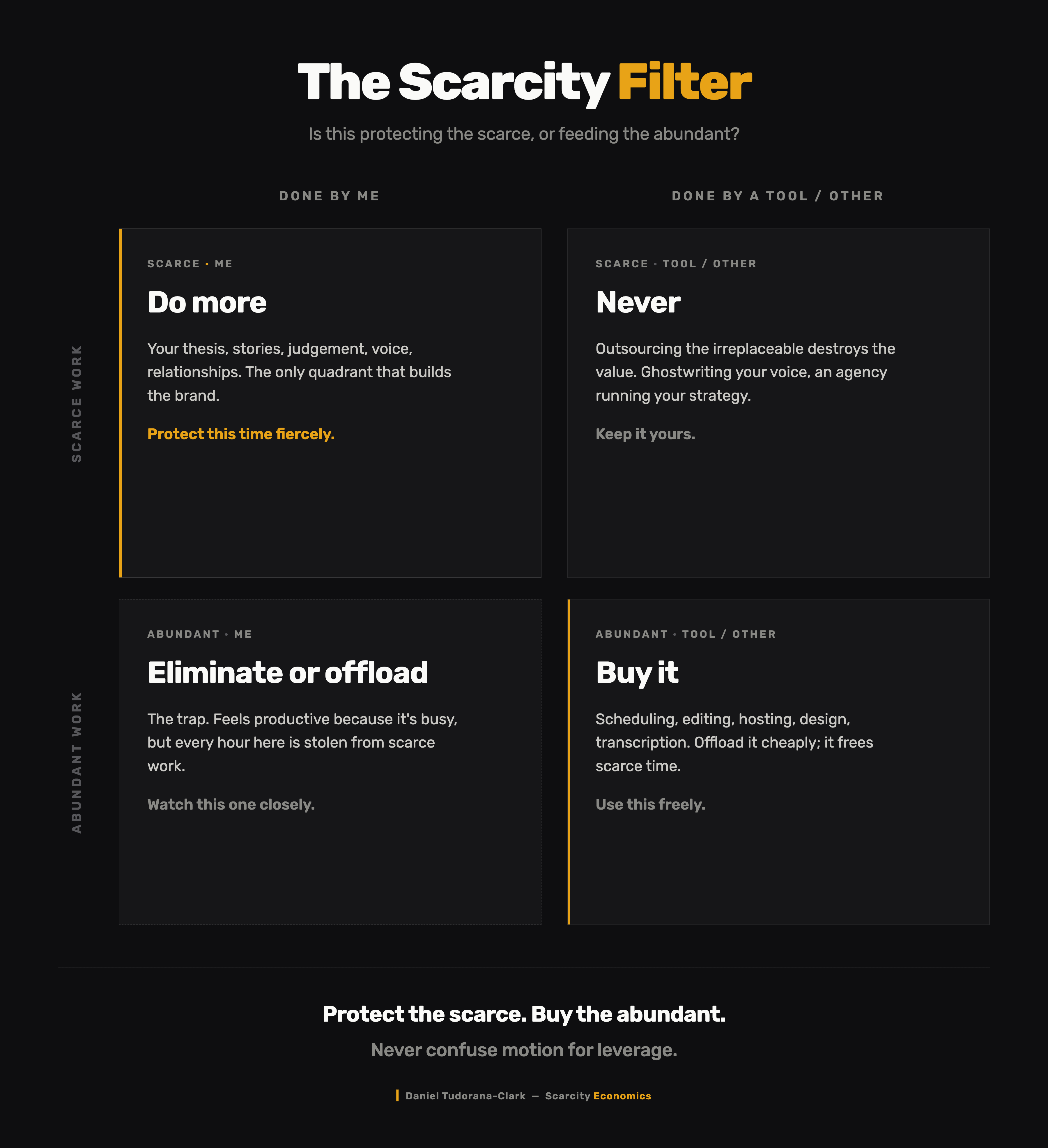
Scarce work, done by you. Do more.
This is the only quadrant that compounds.
Writing your thinking. Developing your framework. Building relationships that cannot be templated. Making the strategic calls that require your specific judgement and no one else’s.
Every hour here builds something that keeps working after the hour ends. A piece of writing someone returns to. A relationship that routes opportunity toward you. A reputation that walks into rooms before you do.
Most professionals spend less than 20% of their week here. The rest is consumed by the other three quadrants, two of which are traps.
Abundant work, done by a tool or someone else. Buy it.
Scheduling. Formatting. Editing. Transcription. Hosting. Design production. Anything that is useful and necessary but does not require you to be you.
Buy it. Automate it. Delegate it. This quadrant should cost money, not time. Every pound you spend here is buying back hours for quadrant one. That is not a cost. It is an investment in your scarce time.
The SaaS subscription you are considering building yourself lives here. Almost always. The monthly fee is not waste. It is the price of staying in the right quadrant.
Abundant work, done by you. Eliminate or offload.
This is the trap. And it is where most professionals spend the majority of their week.
It feels productive because you are busy. Output is visible. Progress feels real. The competence trap is particularly cruel here because you are often genuinely good at the abundant work. It is comfortable. The system rewards it in the short term.
But every hour spent in this quadrant is stolen from quadrant one. Directly. There is no neutral. Time spent on abundant work done by you is time not spent on scarce work done by you. That is the whole trade.
Building the custom tool instead of subscribing to the existing one. Maintaining infrastructure that a managed service could run. Fiddling with systems because you know how they work and fixing them feels satisfying.
I have done all of it. It is the quadrant that costs the most and announces itself the least.
Scarce work, done by a tool or someone else. Never.
Your voice. Your judgement. Your framework. Your relationships.
These cannot be outsourced without destroying the value. Not because the output would be worse, though it often would be. Because the value of scarce work is inseparable from its origin.
A ghostwritten post in your name is not your thinking made more efficient. It is your thinking replaced. A strategy built by an agency running your positioning is not your strategy with better execution. It is someone else’s strategy wearing your name.
The moment you outsource the irreplaceable, it stops being irreplaceable. And it stops being yours.
This is the quadrant most people think they are protected from. Few of them are.
How to use it
The filter is not a planning tool. It is a decision metric.
When a task arrives, or a tool is pitched, or a project is proposed, run it through two questions before anything else.
Is this work scarce or abundant? Could someone or something else do it without being me?
The intersection tells you what to do. Do more. Buy it. Eliminate. Never.
One verdict. No committee. No extended analysis. The filter is designed to produce a position, not a conversation.
The three checks for when it is ambiguous:
Am I doing the abundant work because I am good at it and it is comfortable? That is the competence trap. Stop.
Am I thinking about this instead of doing the scarce work? Understanding the problem is not the same as solving it. That is the intelligence trap. Decide and move.
Is this building something scarce, or just keeping me busy? Motion is not leverage. Test it honestly.
What changes when you use it
The filter does not tell you to work less. It tells you to work differently.
Most professionals who run their week through it find the same thing. The scarce work they should be protecting is buried under layers of abundant work they are doing themselves. The writing that never gets written. The relationships that never get built. The thinking that stays in their head because the week ran out before it got on the page.
The filter surfaces the trade you are making every week without realising it.
I built it because I kept making the wrong trade. Twenty years of engineering capability pointed at problems that a forty-pound-a-month subscription would have solved. Months of my own time building incomplete tools while the work that actually mattered waited.
The question is not whether you can build it.
The question is whether building it is the most scarce thing you could be doing with that time.
Almost always it is not.
Protect the scarce. Buy the abundant. Never confuse motion for leverage.